Equipment
Testing a saddle or comparing two riders with data
Amateur and professional rider, usual saddle and trial saddle: two real cases where Alogo Move Pro data confirmed what the rider was feeling.
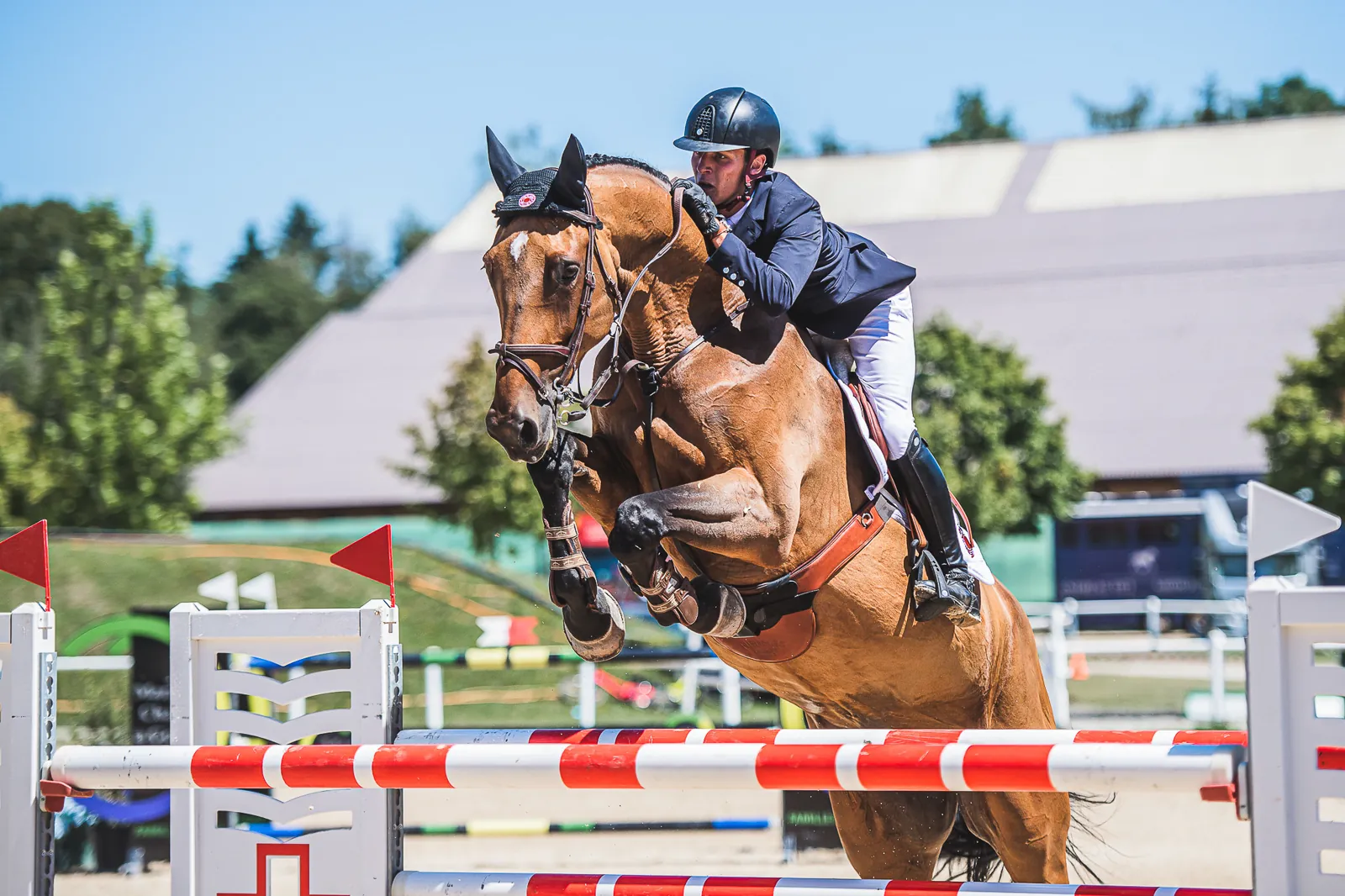
Alogo Move Pro is also a way to measure changes and differences: between two riders on the same horse, or between two pieces of tack. Here are two real cases, followed by a method to test your own equipment.
Compare your horse's data from one rider to another
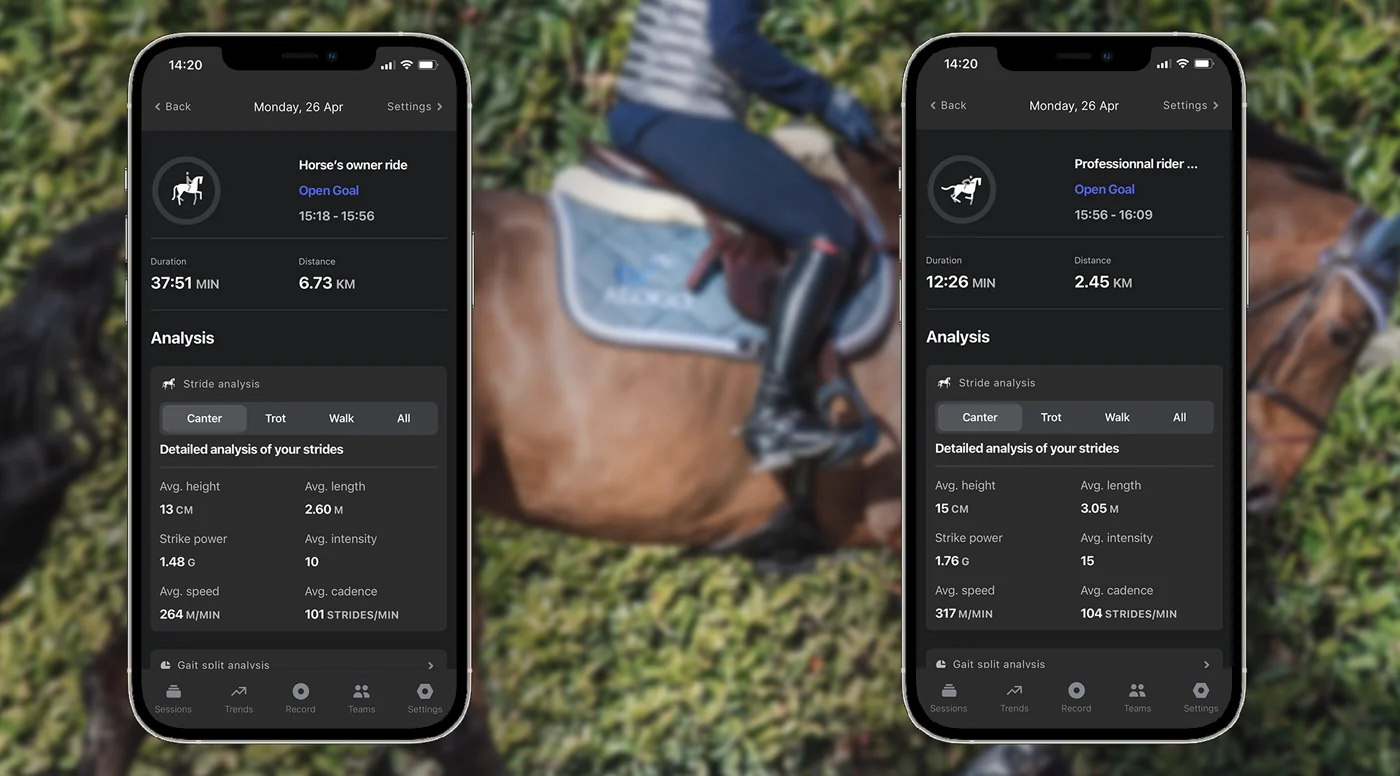
First case: the same horse, ridden by an experienced amateur rider, its owner, and then by a professional rider.
What the professional rider's session shows
The professional rider rode this horse with more energy. Compared with the amateur rider's session, we measure:
- +2 cm of stride height;
- +45 cm of stride length;
- +0.28 g of impact power at each stride.
The amateur rider now has concrete references for what she can aim for with her horse in her sessions, with or without a trainer.
This kind of comparison is useful well beyond this case. Does your trainer, a friend, a client or a sharer ride your horse? Compare their data with yours. Is your horse consistent with everyone, or does it change depending on who rides it? Are the difficulties you meet easily fixed with another rider, or do they show up there too?
There is no such thing as bad data. Every horse has its own particularities and every rider their own way of riding. The data helps you keep what works and improve the rest, with the advice of professionals.
Measure the effect of a saddle on locomotion
Second case: a rider was wondering how her mare moved in her current saddle. She sometimes felt the mare was restricted. We measured the effect of two saddles with Alogo Move Pro. The first was her usual saddle, made for the mare two years earlier. The second was a trial saddle from another brand, suited to the mare but not made to measure.
The protocol was the same for both saddles: same mare, same rider, same tack except for the saddle, same weather, and the same number, height, approach and profile of fences.
On the flat
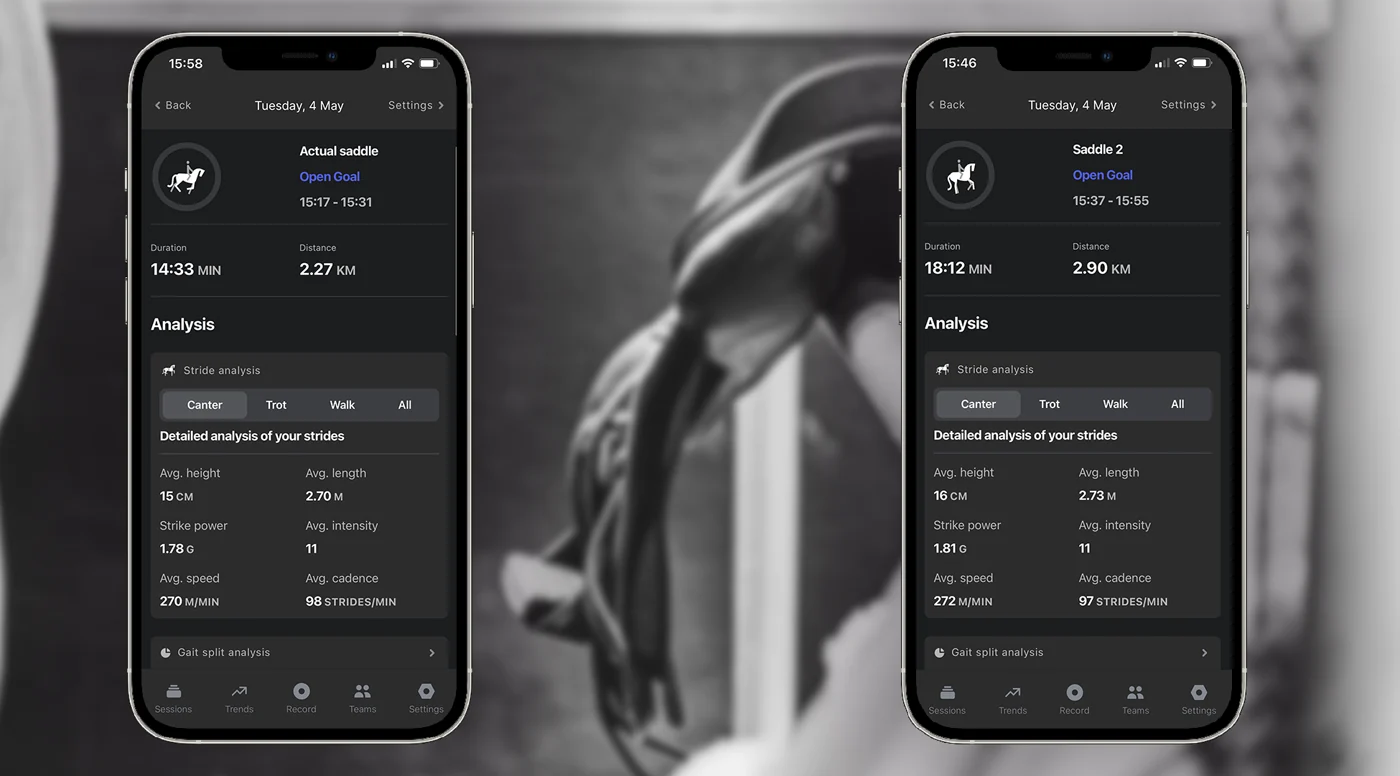
With the trial saddle (right-hand screen), the mare's locomotion clearly improves:
- +1 cm of stride height;
- +3 cm of stride length;
- higher impact power.
She moves more freely forward, with more air time and more spring. The trial saddle gives her shoulders and back more freedom, which improves the quality of her movement.
Over fences
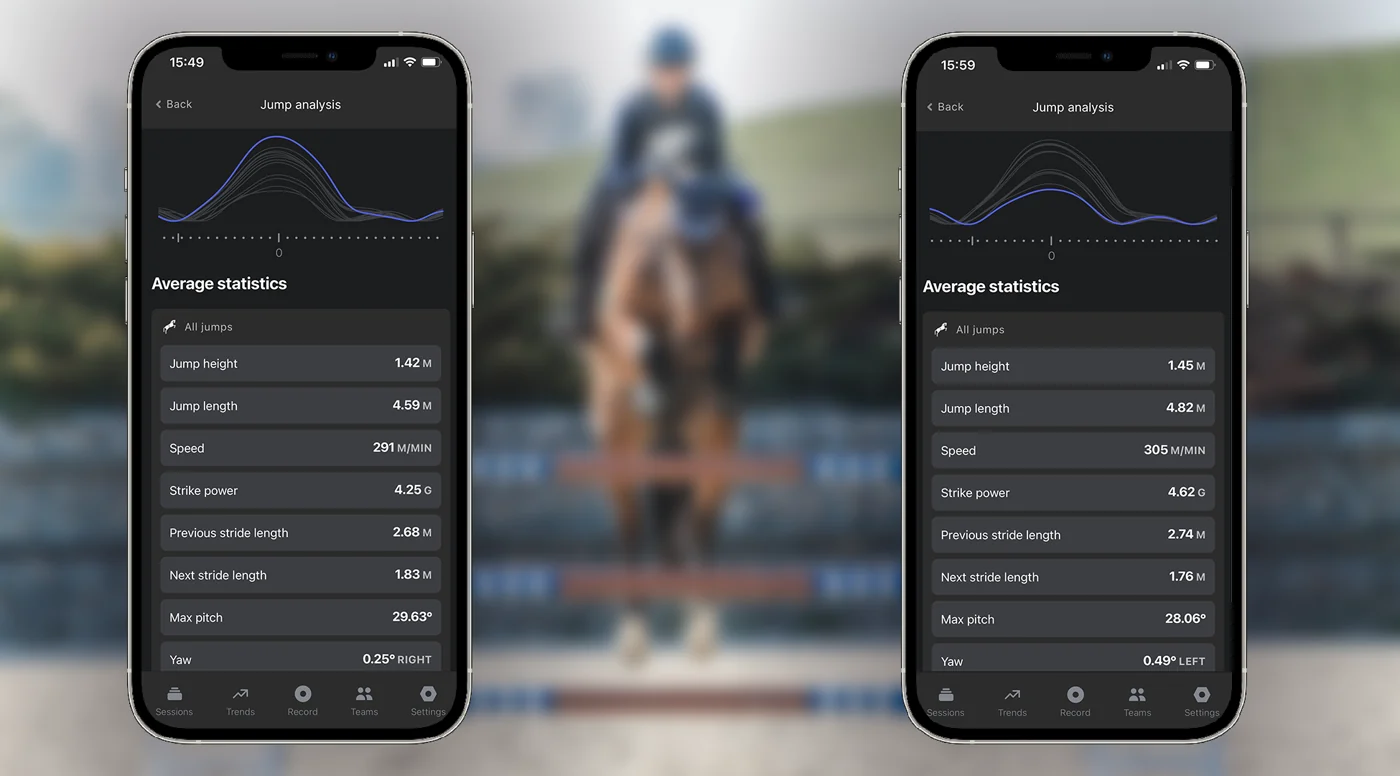
In the trial saddle, the mare also repeats her jumps with great consistency. The trajectories overlap almost perfectly, in only three groups depending on the height of the poles and the fence profile. They overlap so closely that you might think there are fewer jumps on the right than on the left, when there are twelve on each side. Impact power, jump length and jump height also increase: the trends seen on the flat show up over fences too.
When the rider's feel meets the data
In both cases, the data confirmed what the rider was feeling. It can be hard to tell whether a horse is going through a bad patch because it is sore somewhere or because its tack does not suit it. Measurements help you tell the two apart. And if health is at stake, irregularity detection in Alogo Health helps you know when to call your vet.
Testing your own tack: the method
We used saddles as the example, but the same approach works for a bit, a saddle pad or any other piece of equipment:
- Record a few baseline sessions with your usual tack.
- Change only one thing at a time.
- Keep everything else the same: rider, footing, exercises, fences and, as far as possible, time of day and weather.
- Compare strides, balance and jumps over several sessions, not just one.
- Weigh the data against your own feel and the opinion of your saddle fitter, vet or osteopath.
Photos: Soraya Exquis.
First published in 2021 on our former blog, this article has been updated. Some screenshots show an earlier version of the Alogo app.