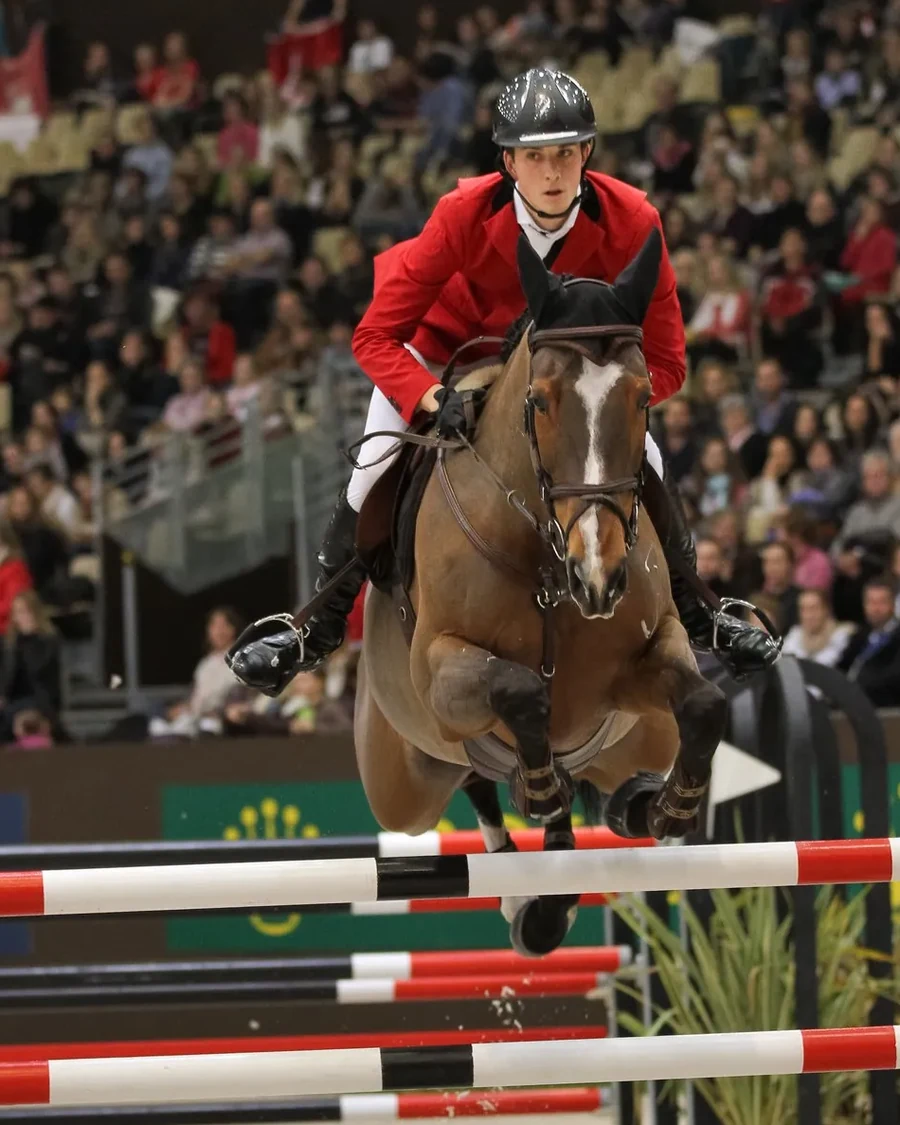
A catastrophic breakdown is almost never sudden. The stride starts changing long before anyone can see it. Alogo — a small device placed on the girth — gives your team a second set of eyes on the whole string, flagging the first signs of musculoskeletal trouble weeks before they reach the eye, even an expert's.
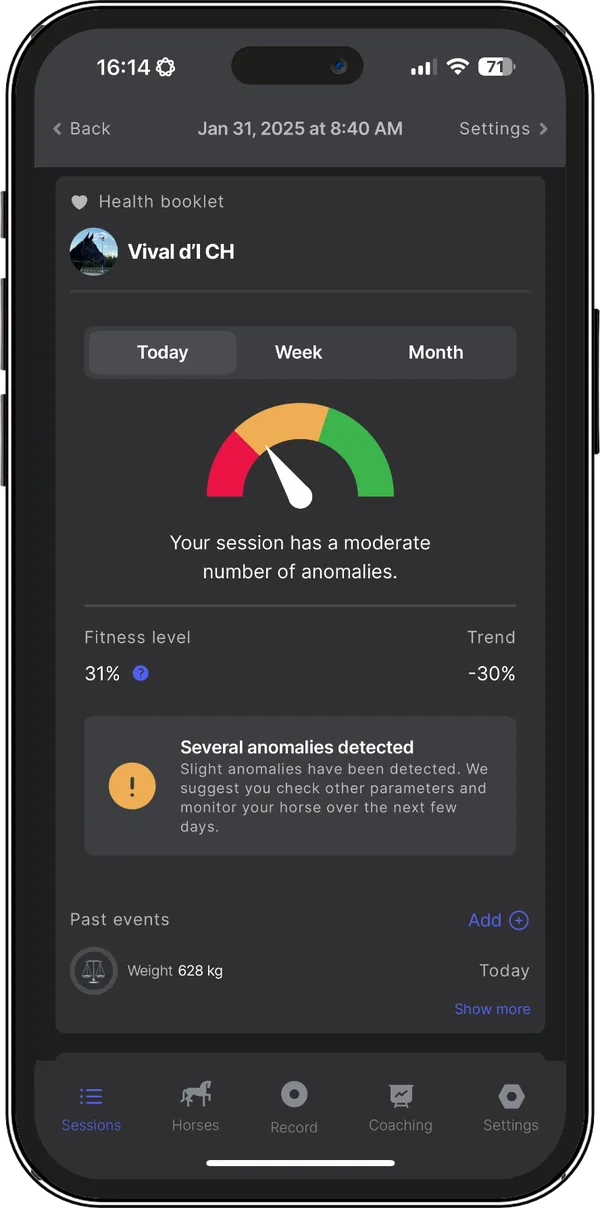 Continuous watch
Alerted at the first sign
Continuous watch
Alerted at the first sign
The onset is silent. Subtle stride changes build for weeks while the horse still works, still cleans the feed tub, still looks sound to a sharp trainer and a good vet. By the time something is visible, the damage is often already done: a career interrupted or ended, months of rehab, real money in diagnostics and surgery.
You don't buy a horse. You buy a future - a campaign, black-type, a stallion or broodmare career, a return on a serious investment. And all of it rests on one fragile thing: staying sound.
flat racehorses are hurt at least once over two seasons - 23-26% every year.
Ramzan & Palmer, The Veterinary Journal, 2011re-injure within three years of a first tendon injury - the same horse, hurt again.
O'Meara et al., Equine Veterinary Journal, 2010of flat-racing fatalities are caused by catastrophic limb injury - the leading cause of death in racehorses.
Boden et al., Equine Veterinary Journal, 2006The warning is in the stride long before it's in the leg. Now you can read it.
Alogo learns each horse's own normal, then watches for it to drift - session after session, breeze after breeze. One small Swiss sensor on the girth line captures 150+ parameters per stride at 100 Hz and turns them into a single, honest signal your team can act on.
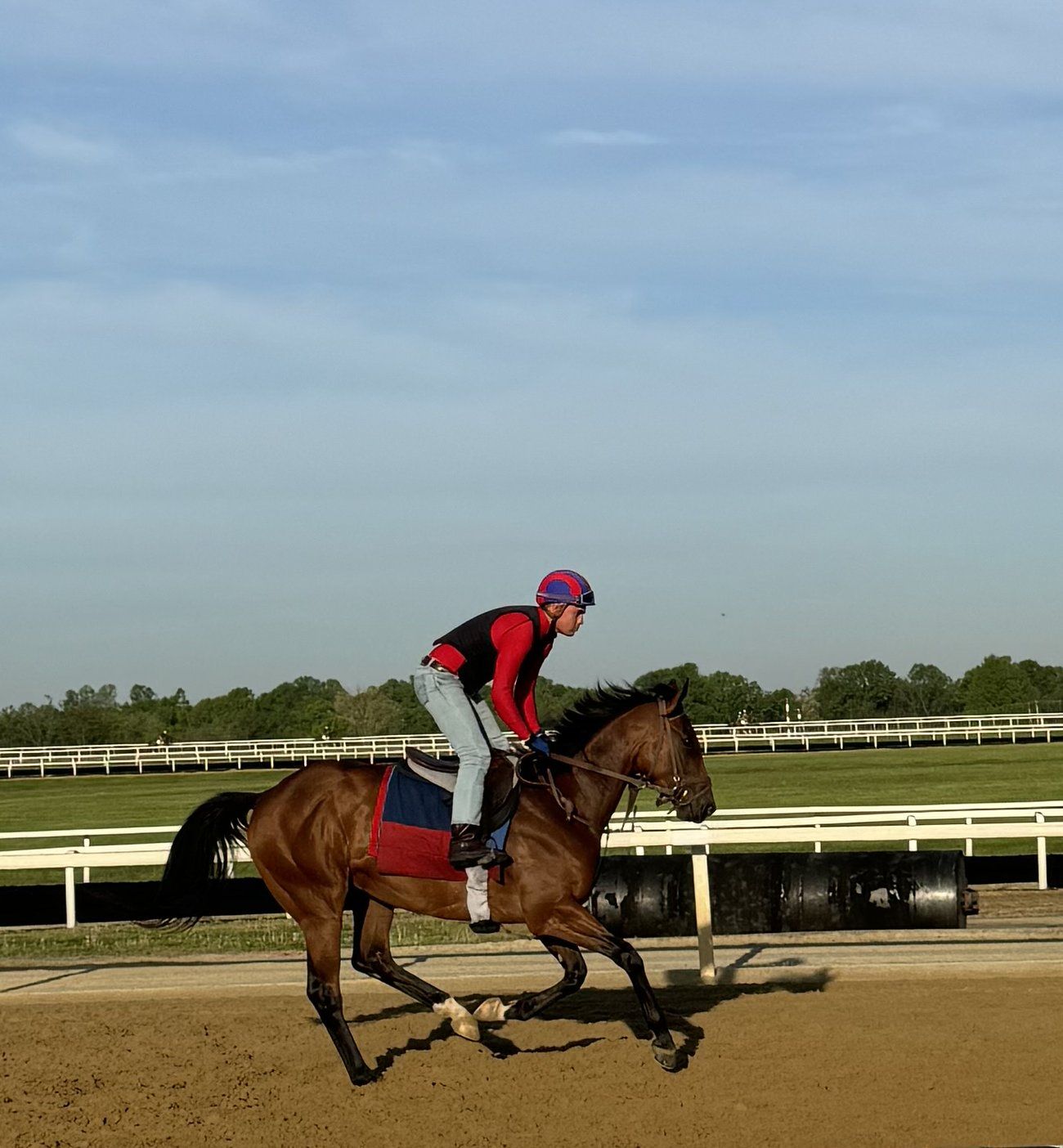 150+ params / stride
A second set of eyes across the entire barn - never tired, never rushed, never assuming a quiet horse is a sound one.
Anomaly detection up to ~5 weeks before clinical signs are visible - the window in which rest, not surgery, is still the answer.
Every morning, one clear status per horse. Green: carry on. Yellow and Red: look closer, today, at the right horse.
An alert is not a diagnosis. It is an invitation to look - at the right horse, at the right moment, while you still have time. Alogo complements your team; it never replaces the trainer's eye or the vet's judgment.
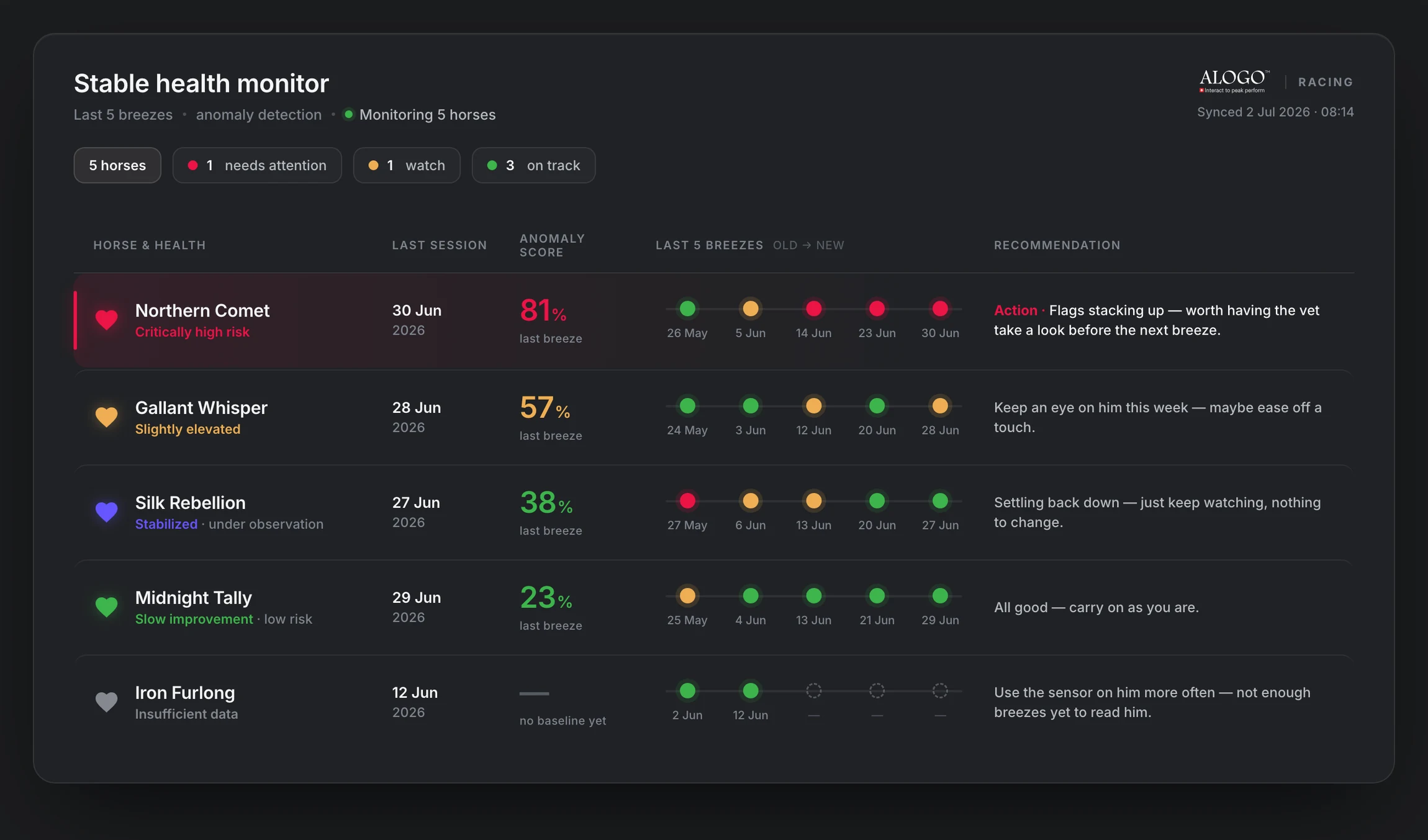
Every horse, one line: the last five breezes, health status, anomaly score and what to do next - so you know exactly which horse to look at before you leg up.
The Racing Edition is the same proven Move Pro hardware - ~29% more compact (~129 cm³) and fully integrated into the overgirth, with a new one-touch push button. Nothing changes about the work.
Use your own phone, iPad or computer - or let the automated Alogo Sync Box upload the whole string seamlessly after work. Nothing extra for your crew.
The Alogo Performance platform turns every breeze into clear visualizations, a simple status, an AI Trend, and stable reporting that fits the whole barn on one screen.
Official alert rules: one Red session, three consecutive Yellow sessions, or a Trend that rises sharply against the horse's recent weighted average. Plus single-stride detection · 3D path mapping · efficiency, energy & strike power · lateral, longitudinal & straightness analysis · optional heart rate.
The same proven, scientifically-validated Move Pro - re-engineered for the track, with a barn-wide system that gets every horse's data in with zero hassle.
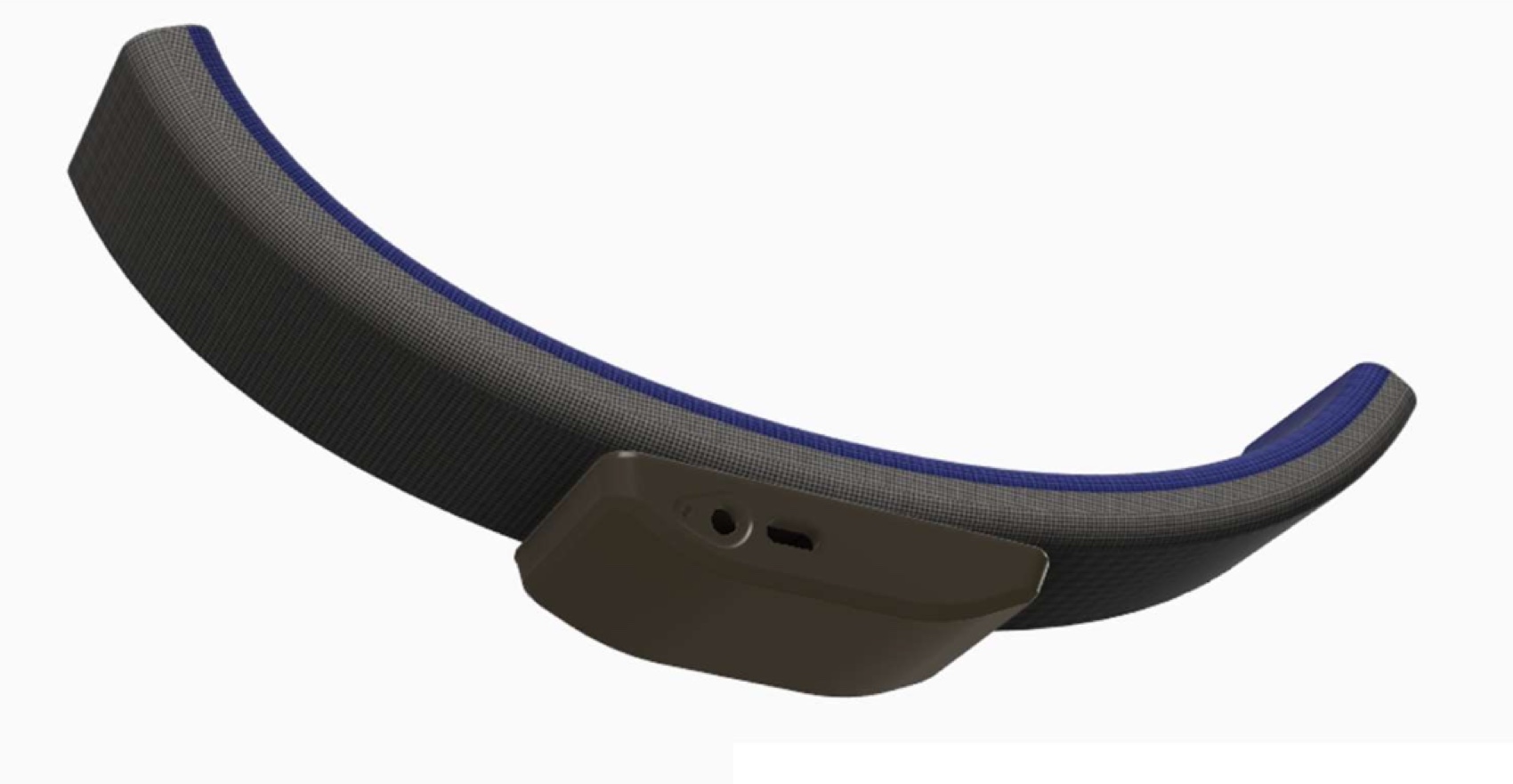
The same proven hardware, fully integrated into the overgirth with a new one-touch button. A single sensor on the girth line - nothing for the horse to notice.
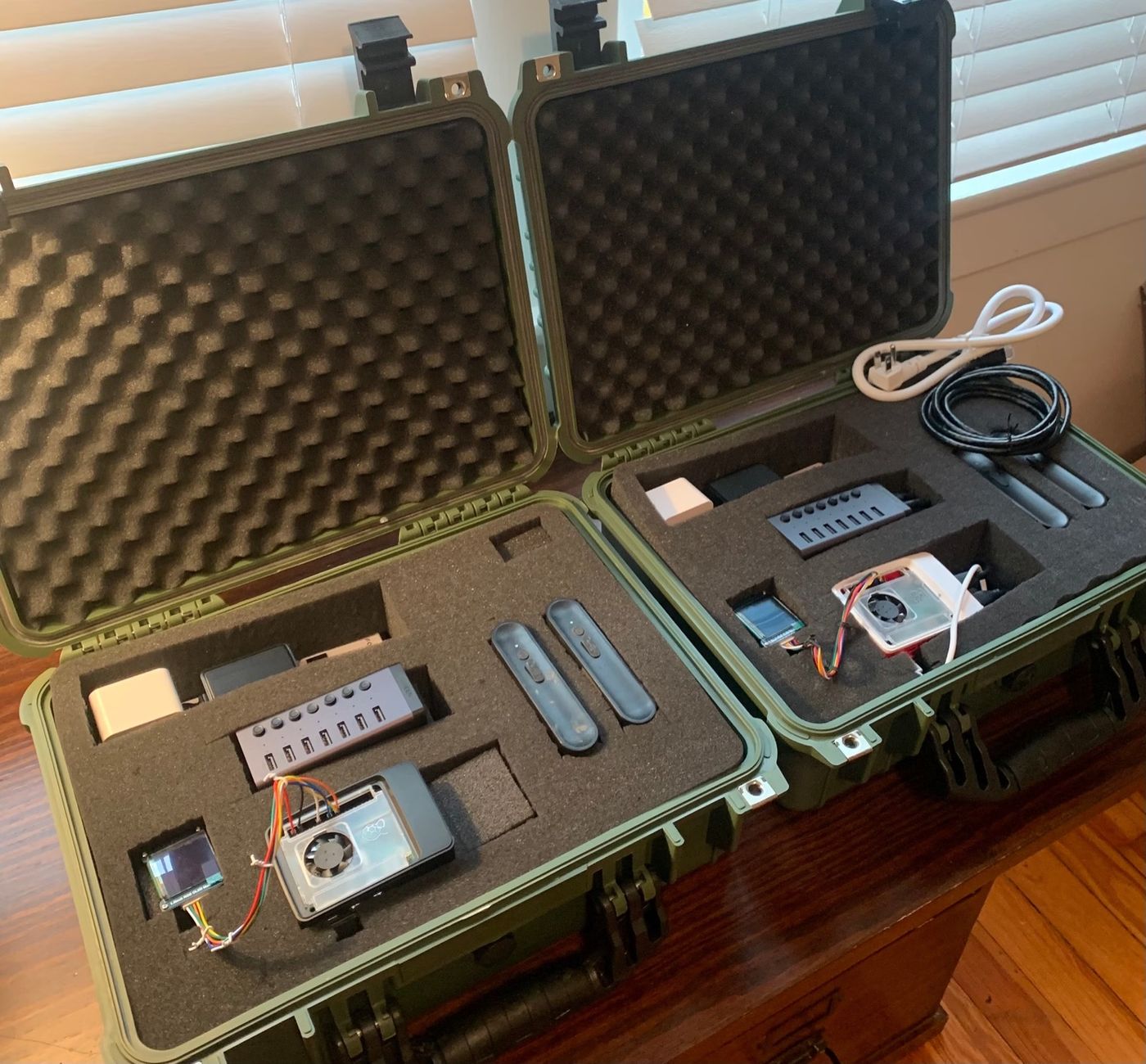
Drop it in the barn and forget it. After work, every sensor uploads automatically - no phones, no per-session syncing, nothing extra for your crew.
Alogo measures locomotion objectively, breeze after breeze, and flags deviations from the horse's own normal - the kind tied to the conditions that quietly end campaigns.
Alogo detects locomotion anomalies and deviations in movement - not a clinical diagnosis. It points your team to the horse and the moment worth examining; the diagnosis is always the veterinarian's. Detection performance varies by pathology type and is strongest for progressive conditions.
In 2025 the AAEP - the American Association of Equine Practitioners, the leading US body of equine veterinarians - ran an independent, year-long, multi-vendor field evaluation of wearable sensors for the early detection of musculoskeletal injury in two-year-old Thoroughbreds. More than 700 two-year-olds wore sensors through high-speed breezes; six sensor companies were selected. Independent analysis was led by Dr. Peta Hitchens, University of Melbourne.
"This study was not intended to validate the use of sensors as a tool to scratch horses from competition on race day but rather to validate if sensors can provide more information about a racehorse's physical condition prior to a horse being entered to race."- Dr. Sara Langsam, AAEP Racing Committee Chair
The AAEP evaluation is a multi-vendor study with no public ranking or winner; the findings above are program-level across the analyzed sensors. A second set of eyes - never a replacement for the trainer's eye or the vet's judgment. Source: AAEP announcement →
Beyond health, Alogo breaks the work down furlong by furlong: speed, stride length and cadence, where top speed is reached, and how balance shifts through the run. See which part of the work cost time - and how to ride it better next breeze.
Top speed, stride length and cadence per furlong.
Longitudinal & lateral balance, straightness, efficiency.
Alogo Coach AI emails a plain-language report each month.
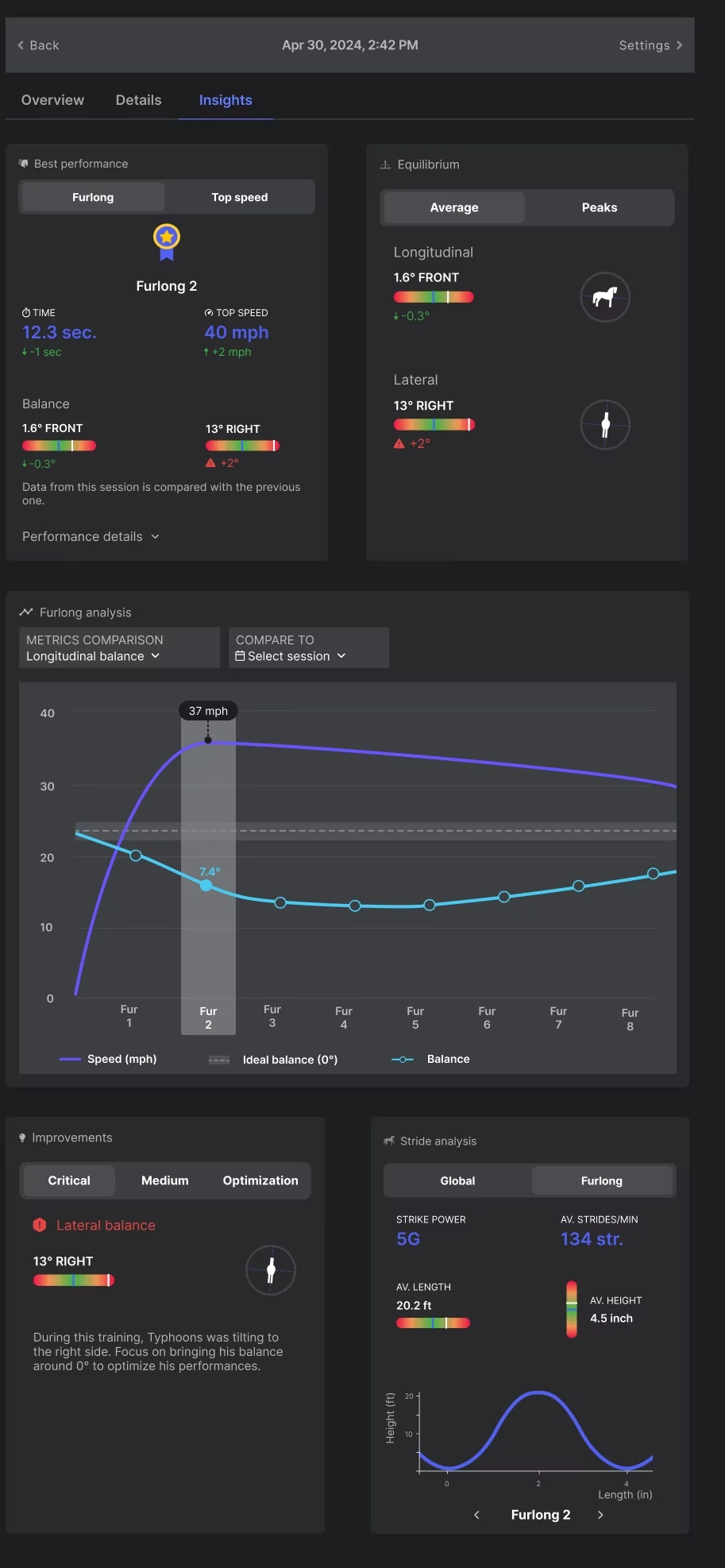 Furlong analysis
The Performance monitor tracks each horse's vitals - stride length, cadence, stride height, speed - and compares every work to that horse's own usual range, never to the barn average. Baselines are workout-conditioned: a breeze is compared only to breezes, a canter to canters - so the numbers reflect the horse's condition, not how hard the rider worked that day. What it's watching for: creeping fatigue. Stride length and cadence sliding below a horse's own range at the same work intensity are often the first quiet signs it needs easing - visible in the numbers before they're visible from the rail. One vital drifting = watch; two or more = attention.
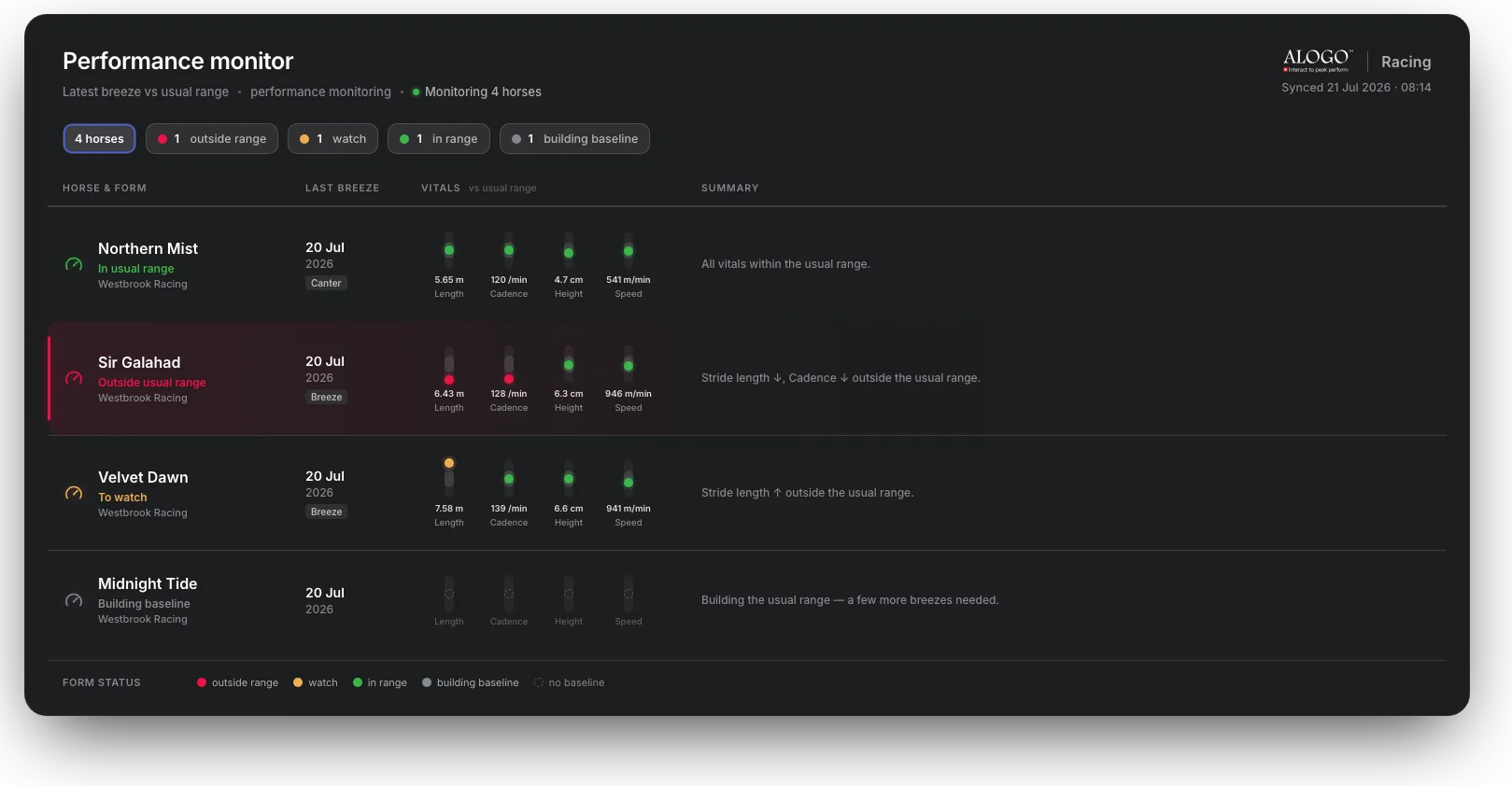
A season, a stakes campaign, a breeding career - all resting on one thing staying sound. Protect the whole string.
A racehorse in training runs about $125 a day - and roughly $1,000 a month (~$12,000 a year) in veterinary care alone. With around one in four horses hurt each year, the question isn't whether you'll pay for injuries - it's whether you catch them early or late.
Real US fees - AAEP Equine Veterinary Fee Survey, 2024. One serious injury runs into the thousands, plus a season lost.
Under 4% of the day-rate - $120 a month per horse. Sensor, platform, anomaly detection, stable reporting and support - all included.
Turn even one would-be surgery and a lost season into trouble caught early, and the saving can cover a year of monitoring for the entire string.
Operating figures (day-rate, monthly veterinary spend, ~25% annual injury rate, 100-horse barn) are industry-typical estimates shown for illustration; procedure costs are from the AAEP Equine Veterinary Fee Survey (DecadeOne / VMG 16), 2024. The whole-string figure uses the 51+ volume rate ($79 / horse / mo). Alogo helps your team act earlier - it does not diagnose, and does not guarantee prevention or savings.
See what a second set of eyes finds on your own horses, before anyone else can.
A trainer was certain the horse was fine. Across several sessions, Alogo flagged a locomotion profile quietly drifting from the horse's own normal. After the repeated alerts, a veterinary exam found early inflammation in both front fetlocks. No fracture. No surgery. Caught in time, the horse needed only rest and care.
That's the difference between a few weeks off - and a campaign, and a large share of value, lost. The alert didn't make the diagnosis. It pointed the vet to the right horse, at the right time.
"I lived through the moment every horseman dreads: sensing that something's wrong, without being able to name it. I built Alogo so no team has to face that doubt blind again."
Technology built by someone who has lived the pressure of top-level competition and the bond with a horse - not by a lab disconnected from the ground.
Only through regular, consistent monitoring - using Alogo technology - can owners, trainers and veterinarians proactively support the soundness, performance and well-being of their equine athletes.
No - and that's not its role. Alogo is a second set of eyes that watches continuously and objectively. It flags where to look and when; the trainer keeps the call and the veterinarian makes any diagnosis. As the AAEP put it, sensors are "an effective complement to veterinarian and trainer oversight."
The AAEP (American Association of Equine Practitioners) ran an independent, year-long field evaluation of wearable sensors on more than 700 two-year-old Thoroughbreds during high-speed breezes. Six companies were selected; Alogo is one of four whose data met the bar and was analyzed. It is a multi-vendor study with no public ranking or winner - the program-level findings are reported by the AAEP, not Alogo-specific results.
Alogo flags deviations from a horse's own normal as the stride starts to change - up to around five weeks before clinical signs become visible. "Early" means objective locomotion change before it's visible to the eye, even an expert's - not a prediction of a specific injury. Detailed peer-reviewed field-study results are publishing soon.
Yes - separately from the AAEP project. The Alogo Move Pro was validated against the Qualisys optical motion-capture system (the worldwide reference) and published in Sensors (Guyard et al., 2023). The single-sensor anomaly-detection method is published (Savoini et al., 2025).
Yes. The Racing Edition sensor is integrated into the overgirth and changes nothing about the work. The automated Alogo Sync Box uploads the whole string seamlessly, and stable reporting fits every horse on one screen - one clear status line per horse, every morning.
Your data is yours. You decide who has access - typically you, your trainer and your veterinarian. We never sell your data, and we don't share an individual horse's results with third parties without your permission. Real transparency on the condition of what you own, session after session.
Yes - and we'd encourage it. Alerts and reports are easy to share with your vet, so the right horse gets examined at the right moment. Alogo points to the horse and the timing; the diagnosis always stays with your veterinarian.
Alogo is a Swiss company, and the Move Pro is already used by leading stables across the US and Europe. In many regions we can come to your barn to fit your string - ask us about yours.
No. Start with a 90-day pilot on up to 10 horses at the $99/horse/mo pilot rate - baselines for every horse plus your first stable report - then roll into the 12-month program, or send the sensors back. We tailor the program to the size and season of your operation.
Request a demo and we'll bring Alogo to your barn, fit your string, and let it learn your horses. We tailor a program to the size of your operation - talk to our team.
Bring Alogo to your barn and let it learn your horses - then see what a second set of eyes finds before anyone else can.
Prefer to see the numbers first? Ask for the field-study briefing.
info@alogo-analysis.ch · alogo.io
Per horse in active training - all-inclusive: sensor, Alogo Sync Box, platform, anomaly detection, stable reporting and support.
After checkout, we contact you to schedule onboarding and fit your string.
Large string or a custom setup? Talk to our team